How to Identify Failure, Causes, and Solutions in Industrial Applications

In an air pneumatic or a fluid system, a solenoid valve is seemingly a small element; however, as soon as the valve begins to deteriorate, the machine becomes unstable or unoperational.
From cylinders that stall or don’t want to move to unaccountable pressure loss and the phenomenon of “overheating” coils, the symptoms of a bad solenoid valve could be the initial warning signs exhibited in the shop floor.
Knowledge of these symptoms enables maintenance engineers, OEMs, and system integrators to diagnose malfunctions early on so that downtime can be minimized.
This guide covers the most common symptoms of solenoid valve failure, causes of those symptoms, methods to perform diagnosis, and selection considerations based on actual industrial practices.
Typical Bad Solenoid Valve Symptoms at a Glance
- Valve fails to open or close
- Intermittent or unstable operation
- Abnormal buzzing or clicking noise
- Solenoid coil overheating or burning smell
- Air or fluid leakage
- Slow response time
Each symptom points to a specific electrical or mechanical issue that should not be ignored.
What Is a Solenoid Valve?
A solenoid valve is an electromechanical device used to control the flow of air, gas, water, or oil. It operates by using an electromagnetic coil to move an internal plunger or spool.
When energized:
- The coil generates a magnetic field
- The plunger shifts position
- The valve opens or closes the flow path
Solenoid valves are widely used in:
- Pneumatic automation systems
- Industrial machinery
- HVAC equipment
- Process control systems
- Medical and laboratory devices
Industrial manufacturers such as ABB, Parker, and SMC favor solenoid valves for their fast response time, compact design, and easy integration with automated control systems.
Why Recognizing Bad Solenoid Valve Symptoms Matters
Solenoid valves rarely fail without warning. In most cases, failure develops gradually.
Ignoring early symptoms can lead to:
- Unstable pneumatic cylinder movement
- Pressure loss and increased energy consumption
- Coil burnout and electrical damage
- System contamination
- Unexpected machine downtime
Early diagnosis improves system reliability and significantly extends the service life of downstream components.
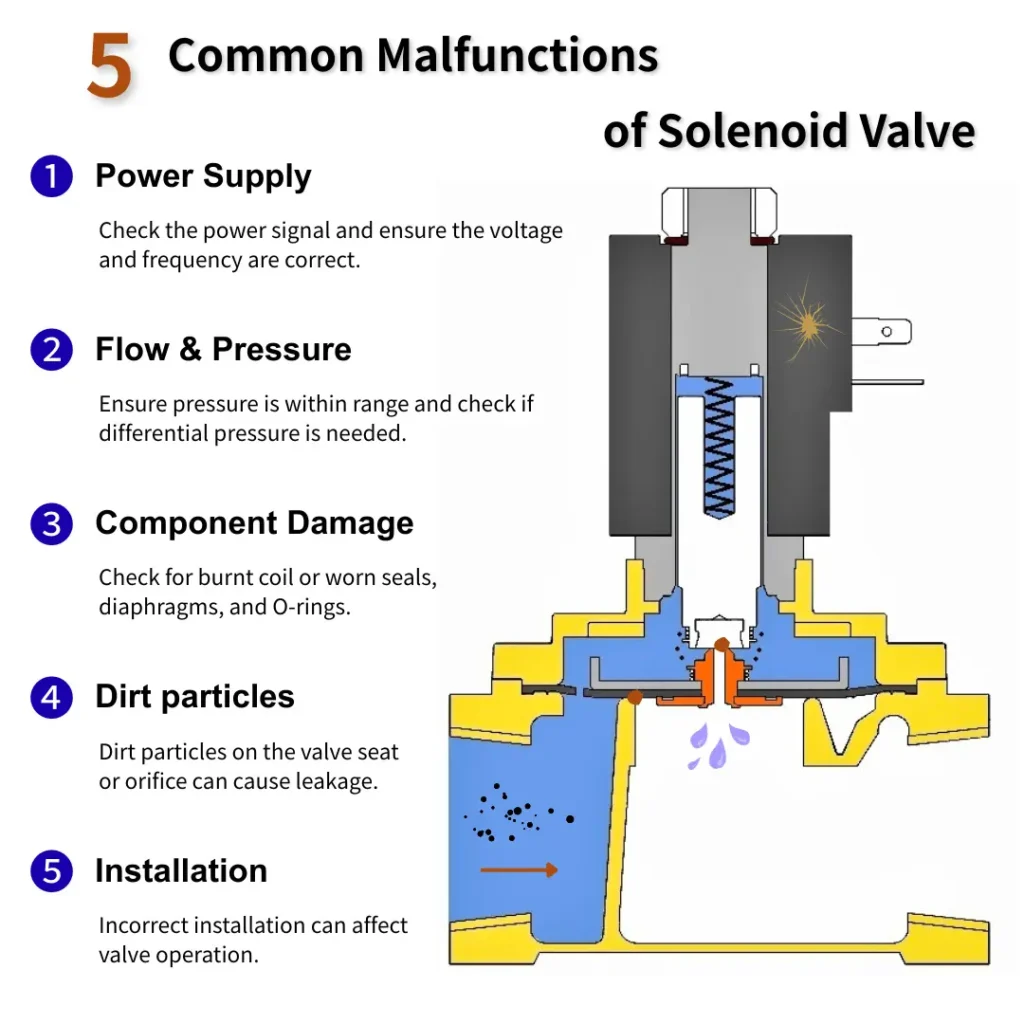
Common Bad Solenoid Valve Symptoms
1. Valve Fails to Open or Close
Symptoms:
- No airflow when the valve is energized
- Actuator or cylinder does not move
- Valve remains stuck in one position
Possible Causes:
- Burned or open solenoid coil
- Dirt or debris blocking internal movement
- Incorrect or insufficient voltage supply
- Worn or damaged internal seals
This is one of the clearest signs of a bad solenoid valve and usually indicates electrical failure or internal contamination.
2. Intermittent or Unstable Operation
Symptoms:
- Valve works inconsistently
- Random delays or incomplete switching
- Unpredictable system behavior
Possible Causes:
- Loose electrical connections
- Coil overheating
- Internal wear of the plunger or return spring
- Marginal or unstable power supply
In automated production lines, intermittent solenoid valve operation often causes mistimed cylinder strokes, sensor errors, or PLC alarms—making troubleshooting more difficult if the valve is not checked first.
3. Unusual Buzzing or Clicking Noise
Symptoms:
- Loud humming, buzzing, or rapid clicking
- Noise increases under load
Possible Causes:
- Low or unstable voltage
- Damaged coil insulation
- Incorrect AC or DC coil type applied (for example, an AC coil connected to DC power)
- Plunger not fully seating due to contamination
A mild hum can be normal, but excessive or irregular noise is a clear warning sign of an underlying problem.
4. Coil Overheating or Burning Smell
Symptoms:
- Coil becomes excessively hot
- Insulation discoloration
- Burning odor near the valve
Possible Causes:
- Overvoltage
- Intermittent-duty solenoid coil used in continuous-duty applications
- Blocked plunger causing continuous energization
- Poor heat dissipation
Excessive heat is one of the primary causes of premature solenoid coil failure in industrial environments.
5. Air or Fluid Leakage
Symptoms:
- Audible air leakage
- Pressure drop in the system
- Fluid seepage around ports or valve body
Possible Causes:
- Worn or damaged seals and O-rings
- Valve body wear
- Improper installation torque
- Chemical incompatibility with the working media
Leakage usually indicates mechanical degradation rather than electrical failure.
6. Slow Response Time
Symptoms:
- Delayed actuation
- Reduced cycle speed
- Incomplete valve shifting
Possible Causes:
- Contaminated air supply
- Weak magnetic force from an aging coil
- Fluid viscosity exceeding valve specifications
- Internal corrosion
In pneumatic automation, slow solenoid valve response directly affects productivity and cycle accuracy.
Common Causes of Solenoid Valve Failure
Most solenoid valve failures can be traced back to a few root causes:
- Contaminated air or fluid due to poor filtration
- Incorrect voltage or coil selection
- Excessive ambient or media temperature
- Improper duty cycle
- Mechanical wear from high switching frequency
Industrial best practices strongly emphasize proper air preparation using FRL (Filter–Regulator–Lubricator) units to protect solenoid valves and extend their service life.
How to Diagnose a Bad Solenoid Valve
Basic Diagnostic Steps
- Visual inspection
Check for physical damage, leaks, or burned coils. - Electrical testing
Measure coil resistance using a multimeter. - Manual override test
If available, verify that the valve shifts mechanically. - Power supply verification
Confirm voltage and current match specifications. - Swap test
Replace with a known good solenoid valve to confirm the fault.
Accurate diagnosis prevents unnecessary replacement of other components.
Solenoid Valve vs Other Pneumatic Issues
| Issue Source | Typical Symptom | Root Cause |
|---|---|---|
| Solenoid valve | No actuation | Electrical or internal failure |
| Pneumatic cylinder | Jerky motion | Seal wear or misalignment |
| FRL unit | Pressure fluctuation | Filter clogging or regulator drift |
| Tubing & fittings | Air loss | Loose or damaged connections |
How to Choose a Reliable Replacement Solenoid Valve
When replacing a failed solenoid valve, correct selection is critical:
- Correct voltage (AC or DC)
- Proper duty cycle rating
- Media compatibility
- Required response time
- Ingress protection (IP rating)
- Operating pressure range
Many repeat failures occur not because of poor quality, but because the replacement valve does not fully match the application conditions.
Preventive Maintenance Tips
- Install proper air filtration
- Use a stable, regulated power supply
- Avoid exceeding rated duty cycles
- Perform periodic inspection
- Replace worn seals proactively
With proper maintenance, industrial solenoid valves can operate reliably for millions of cycles.
FAQ
Yes. Internal coil burnout or insulation breakdown may not be visible externally.
Not always. Mild hum is normal, but loud or irregular noise indicates voltage or mechanical issues.
Under proper conditions, many industrial solenoid valves last 5–10 years or millions of cycles.
Absolutely. Contamination is one of the leading causes of sticking and leakage.
In most industrial applications, replacement is more reliable and cost-effective than repair.
Conclusion
Recognizing bad solenoid valve symptoms early is essential for maintaining safe, efficient, and reliable pneumatic systems. Intermittent operation, overheating, leakage, and slow response are all signs of underlying electrical or mechanical stress.
By understanding these symptoms and selecting the correct replacement valve, engineers and buyers can significantly reduce downtime and extend equipment lifespan.
In industrial automation, a solenoid valve is not just a component—it is a reliability investment.